Showing posts with label air travel. Show all posts

Tuesday, March 22, 2011

Le Sud de France 5.2: Me and My Magic Black Hat

N'est pas un chapeau noir!
Sebastian is a big guy like me, six foot tall and a bit on the chunky side. I met him at a party, where he lumbered in wearing a black “gardien” hat and carrying a guitar case. I had been asked to bring my guitar and seeing him, I realized that he was the other musician for the night. So I went up to him, and standing there eye to eye, introduced myself and said “C’est un beau chapeau.” He nodded slightly and said, “D’accord.”

Now I am not a hat guy. Never wore baseball caps or fedoras, certainly wouldn’t be caught "morte" in a beret on a bet. Nevertheless, the Midi spring was upon us and the sun was already bright and hard. Since I don’t like to wear sunglasses--they interfere with my photography-- a hat with a brim had possibilities; and there was something about Sebastian's that caught my fancy.

Cody's Coming!
A while ago, I wrote about Buffalo Bill and his Wild West Show getting stranded here in France by a terrible winter storm. They ended up wintering about 60 miles from us in the Camargue, the beautiful, marshy Rhone delta that's full of flaming pink flamingos, big black bulls, and wild white horses. It’s the traditional home of the gardiens—French cattle ranchers--and of French gypsies.

During Bill’s sojourn, the gardiens fell in love with the cowboys--mad, passionate male love. They admired the Americans skills at ropin’, ridin’, and shootin' and soon, they were trying to be just like them. The cowboys, of course, fell hard for the French mademoiselles.  


A mademoiselle Gardien with her black hat.
The gardiens’ embrace of all things cowboy is still evident  in the Western tack shops of the Camargue, in town like Les Saintes- Maries-de-la-Mer where they sell American riding saddles, cowboy shirts (although made with colorful Provençal fabrics) and gardien hats. Sebastian is from the Camargue--he’s a French-Spaniard—so naturally, he wears a gardien hat modeled on the American cowboy’s Stetson.

Thinking about his hat, I knew that I needed one. Somehow, it just felt right. Unlike a beret, the gardien nicely expresses an American heritage with a French flair. It would make me stand out as an American who living here. C’est parfait!


Lee's the one
I asked Sebastian where I could get a hat locally and he directed me the Pézenas Saturday market where three days later, I stood in front of a stall full of rain caps, deerslayers, fedoras, flat caps, and berets. I spotted the “gardiens” in a in all sorts of sizes and colors and with a variety of decorative bands. I rummaged through the stack looking for a hat, in unknown territory, relying on “bon chance” to find me the right one.


I tried on a few and then picked up one that seemed a little different from the rest. I put it on and it fit as if it had been born on my head. It looked cool and rakish, making me feel a bit edgy, like Lee Van Cleef on his way to a shootout with Clint Eastwood. 

I bought the hat and strolled home through the market, little suspecting how the hat was going to change my life.

Later that day, I stopped at a supermarket to get some things for dinner and  I entered the store in my black gardien expecting to get a lot of stares. I usually do, as I am taller and bigger than most of the local French folk. However, no one even glanced at me. I walked passed them and they stared right through me. I had become invisible.

At the meat counter, when I asked for a 200-gram slice of dry sausage, the woman at the counter nodded and said, “Une pièce?” “Oui.” I replied. Now, usually when I speak French, people are polite but I can see them wince or cross their eyes at my pronunciation. Sometimes they’ll politely repeat what I said but say it correctly. This time there was no eye crossing and before I knew it, the woman handed me my sausage and I was off.

The Hotel Lacoste
That evening, we went to a gallery opening and I parked in a municipal lot in Pézenas. I went to pay for a time ticket and was about to put money in the machine when a voice behind me rang out, “Monsieur, attendez!”
I turned to see a forty-something brunette in a Mercedes waving her arm at me. In her hand was a piece of paper. It turned out to be her unexpired parking ticket, which she was giving me to use. I took it, she smiled, I smiled and she drove off. Was this luck, I wondered, or the work of the hat?


The opening was in Hótel de Lacoste, one of the oldest buildings in Pézenas and the site of newly discovered ritual baths, once used by Jews during the Renaissance. The gallery itself-- Galerie Anne Cros--is an airy modern space with large windows that overlook a courtyard and gardens.

A black beret--boring
Climbing a long curved stairway, we entered the gallery where were immediately surrounded by a curious crowd. The gallery owner Mme.Cros came over and introduced herself as the gallery's co-owner joined us, vigorously shaking my hand. The two of them chatted us up like long lost relations. When they turned to talk to others, new people came over and struck up conversations. In fact, people came over all evening and several  made a point of praising my hat.

Later looking around the gallery I noticed another man wearing a black hat and beyond him a man with a straw hat and beyond him another with a beret. However, no one seemed interested in them. Very curious.
The show was an exhibition of paintings by a French artist, Christine Trouillet. Her work is delightful with a strong use of color and the blending of abstract and representational elements. I really liked her work, as did the other opening attendees. 


When Christine got to the gallery, I corralled her for a few photos for this blog. In my fine French black gardien hat, I naturally had the authority to do that.
Christine Trouillet


Moi et mon chapeau noir.


Today my black hat and I are still getting to know each other.
It’s finding its way around my head and practicing it’s grip to prevent flying off in the  winds that roar through the Herault.
In fact, while I was adjusting it I walked by our café and Therese the owner waved at me and shouted, “Eh, Steve! Mr.Cool. OK!”


Clearly, the hat makes the man.


Note: If you enjoy Le Sud de France, please pass it on to your friends. Thanks

Wednesday, December 1, 2010

Sud de France 4.4: Out to Lunch at Béziers’ Au Soleil Restaurant & Salon de Thé. .

Au Soleil Restaurant
I define art as something that surprises and delights me and by that standard “Au Soleil” restaurant is a work of art. It is everything a small eatery should be and more. It is an intimate Salon de Thé, at the heart of a city with a dining area decorated with a minimalist sensibility that makes for clean lines and an airy atmosphere.   
“Au Soleil” (In the Sun) is one of several restaurants on the square between Béziers’ la Madeleine church and “les Halles,” its large indoor public market. 

A Roman statue found in the city.
To me, Béziers is one of the most beautiful cities in France but, like so many places, it is struggling to define its future while simultaneously trying to repair past neglect. 

It was settled in Neolithic times, was a Roman town, then a medieval center and then it finally boomed at the end of the 19th century (only to have its fortunes dimmed in the 20th.)


But that 19th century heyday left the city with a legacy of beautiful places. One of my personal  favorites is the “allée Paul Riquet” a several block long, tree lined promenade, with the city’s municipal theater at one end and a delightful English style formal park, the “Plateau des Poètes,” at the other. 
A "Belle Epoque" building in Beziers
The allée itself is surrounded by gorgeous “Belle Époque” buildings replete with lovely terraces and lots of exquisite, intricate ironwork. And it’s just a short walk from Au Soleil, through Béziers’ clothing shop lined streets to the quiet of the allée and the park.

I have photographed and written about food and restaurants for dozens years and I’m pretty jaded about the subject. I’ve been in Michelin star restaurants and in American “Best Places” but for me “Au Soleil” is among my favorites. Simply it is one of the best small restaurants I’ve ever been in. 

At  “Au Soleil” the whole point is the food. We were in the city on some business the other day and decided to have lunch at the restaurant. After settling into our chairs we ordered tea and one of the day’s special, the “La Terroir” plate. Terroir refers to the special nature of the land and this plate is a celebration of the land and autumn. 

Unfortunately when the food arrived I jumped in and started eating, forgetting that I wanted to do some photos first. So please excuse the nibbles I took out of the food in the picture below.

On the plate from left clockwise around you can see a small salad, a duck and potato “parmentier” (which I’ve opened up to reveal the duck), jambon (dried ham) with a red wine confit, a thick autumn vegetable soup (in the glass jar), an onion tart and chicken mousse in pastry (which I cut open too.)

Each of these items was superbly prepared but what really caught my attention was how well their flavors worked together. In my experience the matching of flavors and textures on a plate is one of the hardest tasks for a chef. And as a result I think that you can often judge a chef’s skill by checking out how they've presented the vegetables. 


Most chefs take pride in their main preparation but the vegetables are often an afterthought, put on the plate to provide some color or to fill an empty space. This was not the case  with my “la terroir” plate. The onion tarte was a treat in itself. Moist and light, the egg and onion mixture was hot and perfectly cooked. 

It is not the kind of sensitive and creative care you see every day.

Our lunch cost us about $12 USD each and as I left the restaurant I thought to myself that if “Au Soleil” were in Paris the meal would have easily cost three times as much.

And that’s what is so special about the Herault. It is a region that has been overlooked and bypassed. Undervalued wines and a lack of big name star supporters it lay dormant. But today its the fastest growing region in France, talent and new ideas. With luck in a few years Béziers will become the the Paris or Berlin of Sud de France.

The city hall mural complete with the mayor and the artist.

Saturday, November 6, 2010

Sud de France 3.8: A Day in Sète, the “Venice of the Languedoc.”


Someone wrote once that Sète “smells of fish.” Ptolemy mentioned the town around 75 A.D and he didn’t seem to notice that. But Sète's never smelled of fish when I’ve been there, just a delightful hint of salt in the air from the sea that surrounds the town. 

Sète’s has a unique location, nestled up against the 577 foot (176 meters) high Mount Saint Clair and bordered on one side by the Mediterranean and on the other by the Bassin de Thau a very large, salt water lake.  

 These elements make for a strikingly beautiful setting. Mt. St. Clair stands out high above the nearby landscape that it can be seen from miles off the coast, making it a convenient coastal landmark for sailors for centuries. Today the mountain is home to a number of restaurants and hotels with spectacular views of the harbor and sea. 

The Bassin de Thau is filled with thousands of crisscrossed mussels and oysters growing racks. It is separated from the Med by an eight mile (13.5 km) long sand spit full of sandy beaches and bird filled marshlands. In the past the beaches were packed in summer with campers from all over Europe. Their parked camper vans often blocked traffic but today a newly completed parking and traffic revision has eased the problem. 

Sète is the largest French fishing port on the Med and is called the “Venice of the Languedoc” because of the system of canals that thread through the town. Bridges cross these waterways and while not as Renaissance pretty as Venice, it still makes Sète a lovely water loving city. It’s also the southern end of the Canal du Midi, a manmade waterway that goes all the way through France to Bordeaux and the Atlantic. The Canal is a favorite of boaters who kayak or rent barges to take leisurely up the Canal on a summer vacation. 

The other day we went to Sète for its annual used book fair. Our first surprise  there was parking our car in the underground or rather under the canal lot that was literally cut out of the rock beneath one of the city’s waterways. We drove down through what looked like a cave tunnel. Happily like other parking facilities in France, calming classical music was piped in to the chambers of the lot to reassure drivers that all was okay.  
We were parked under this lady's dog.
 
The used book fair is a modest affair held in the Place d la Republique, a small park with the Mayor’s office on one side of it. Across the park is the main office of France’s second major political party, the Parti Socialiste. I guess the arrangement allows the Socialists to keep an eye on the Mayor. 

The book fair was a small and easy event. A dozen folding tables were set up under the trees and books were laid out in piles. The texts ran from manga Japanese comics to 16th century travel guides.
Browsing the book fair's offerings
 We went through the fair but didn’t find anything special to buy. So we next set off to Sète’s “Les Halles.” Like the Halles found in most large French towns and cities this is a covered produce market with a high glass and iron framed ceiling. Inside the Halles are the usual vegetable and meat stand as well as a number of lively restaurants. 
The sports bar in Les Halles


The owner of Chez Leon Louis on les Halles

In Les Halles we got some olive oil and preserved fruits and then headed out for lunch. Despite it being a late fall Sunday the streets were full of people. Many were shopping others just strolling along the canals. 

We walked a block down from Les Halles to the Quai de la Resistance along one of the main canals. We chose a small sidewalk place from the four or five restaurants that were open. As we entered the place, a waiter dashed by us with a huge tray of clams and oysters perched on his shoulder, evidently he was off to deliver a take-out order. We took a seat under a large tent like canopy facing the restaurant so we could watch the owner standing one side of the sidewalk shucking oysters. He worked calmly and meticulously but always stopped for a minute to greet and chat with passersby. He seemed to know everyone on the street.  

For me the treat is not oysters but the local mussels. I ordered a bucket of moules (mussels) in a light cream sauce that was incredibly fresh and tasty. One of my favorite things about living here in Mediterranean France is access to totally fresh, locally caught seafood. Especially mussels, that are petite and delicate and about a third the size of the monsters mussels (read older and tougher) we’d get back in the Pacific Northwest. 

Finishing lunch and our “demi piche”, half pitcher, of rosé we got up and strolled along the Quai. The whole meal for two us came to under 20 euros.

About a block from the restaurant we came upon “La Biscuiterie, Sucré & Salé. It’s a new shop that’s only been open for a few months and it was doing a lively business. Sucré & Salé bakes and sells only biscuits and Madeleine cakes. 

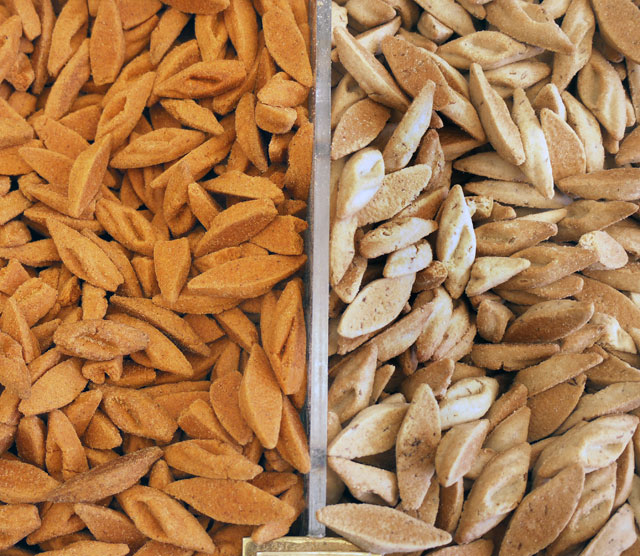
Seemingly simple things you’d think, but they make these two humble cakes something of a culinary art form. They have Madeleine cakes flavored with lemon, with apricot, pistachio, walnut, olive oil, spice, honey, chocolate and more. And the biscuits receive the same treatment spiced with everything from paprika to Provençal herbs.

The two young couples that run the place are taking Proust’s humble Madeleine and improvising on it in a most delightful way. 


Their whole presentation is whimsical and most theatrical.
Naturally we loaded up on cakes which made for a sweet way to end a very pleasant day in the Sud de France.


Tuesday, October 5, 2010

Sud de France 2.3: En attendant les Américains


Summer faded into fall and fall was nipping at winter’s nose as we waited at the Cafe des Vente for the Americans. They had left Charles de Gaulle airport in Paris at 7:30 AM and by any reckoning should be in the l’Herault seven hours later or by about 3:30PM.
It was now 6:30PM.

But let’s rewind for a moment to get the whole story. Our landlord had rented a village house to an American couple. Then she suddenly had to go up to the U.K. on business and could not meet these folks as planned. This put her in a bind. Then she put two and two together and came up with us. Since we speak English and are American too, she asked us to help and being nice people or just foolish we agreed.
Having just arrived in France ourselves we had yet to get French mobile phones we ended up dealing with the Americans via email. So far so good.
It was a setting out to be a stormy, windy day across France when this we got a buoyant email early in the morning.
“We’ve arrived. It is 7:30 AM and we are leaving Charles de Gaulle.” By leaving they meant getting into their rental car and driving from Paris to the Herault a trip of roughly 300 miles. Now this is pure American. In a country with a TGV that gets you that distance in three hours or where $27 gets you a Ryan air flight to here in 90 minutes, choosing to drive for about seven hours after a ten hour flight through six time zones and paying about $140 between gas and tolls was, well, very American. But look we are still red, white and blue (it’s only been four days in France) so our attitude was “you want to drive-okay drive.”
The folks at the online Michelin site say the drive at legal speeds takes seven hours. So leave Charles de Gaulle (CDG) at 8 AM add seven hours of driving and you get here at 3 PM.
Okay, the plan then is to get to the bar at 2:30, drink some coffee and be the happy “Bienvenue et Aloha y’all” greeters.
We get to des Vente, order our coffee and wait under an awning protected from the afternoon rain.
3 PM and the rain subsides, but no Americans.
4 PM the sky clears and it gets a bit colder. Still no Americans.
5 PM and still no Americans.
Let me digress about one of the lovely things about France. For $3, we got two espressos and the right to sit in the café for the rest of our natural lives. The waiters don’t make funny eyes at you or wipe your table every two minutes or ask if your coffee is cold.
The space is yours.
Finally at 6:30 we write a note and ask the bartender to pass it on to any bleary eyed and lost Americans who appear at his door. The note said simply: “eMail or Skype when you arrive.”
Ten we got  home, started dinner and just as we are to sit down to eat--at about 7:30--guess what?
That familiar voice whispered through the evening silence and said “You have mail”
An email from THEM, “Hi, we are at des Vente. Having a drink, see you when you get here. Take your time
Okay, let me be honest here. This was a moment when I was ready to throw my fellow countrymen under the bus. After waiting around without a word or email at the bar for four hours, I had been all ready to settle into a quiet evening, watch the sunset over the pool and have a nice cold Vodka tonic and bore myself to death with British TV.
Okay we are new here in France. Recently gone from the US of A and I certainly don’t want to disparage my fellow countrymen. But people this was not cool. These were the Weakest Link.
But we did our duty as we had sworn to and went back to town and escorted them to their new digs. After a few ‘bye-byes’ and ‘we’ll see you soons’ we drove off.
And I had to wonder where had they been for those extra four hours?
I was annoyed and then annoyance turned to fear.
Just yesterday I had read that the U.S. State Department had issued a terrorist warning for Europe. It said that the Ben Laden Traveling Circus was up to something and everyone should be extra cautious.
Could these seemingly ordinary Americans actually have been secret agents? Or worse, part of a sleeper cell?
And is that what they did? Did they stop on the road to sleep?
Oh my god!!!


Photos and text © 2010 Steve Meltzer

Sunday, October 3, 2010

Sud de France 2.2: Villeneuvette


In France you don’t have to find things to do, things find you. 
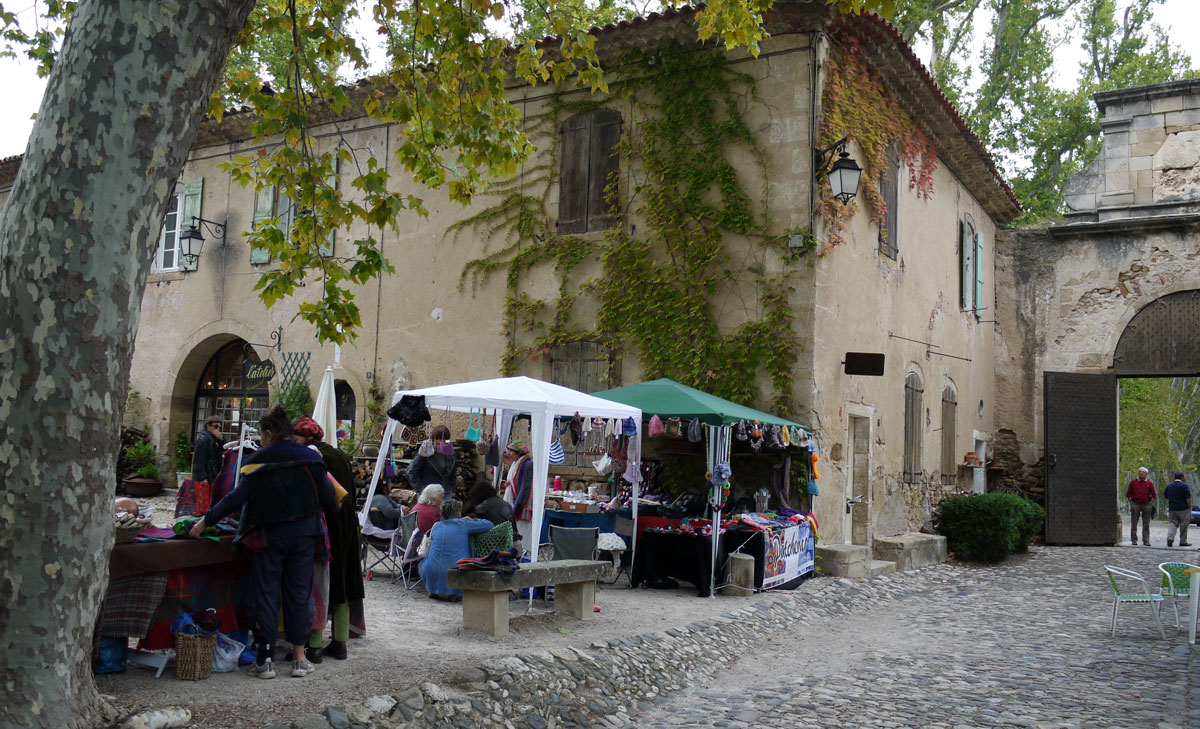
Driving down a local road we saw a sign for a restaurant we had been told about. Turning into the little road the sign pointed to, we came upon the town of Villeneuvette--a walled village from the 15th century or earlier. And in the middle of the town was a wool weavers fair. 

A serious wool weaving fair with weavers dressed in wool clothing that was rural French couture well before the reign of Louis XIV. There was a wool spinning exhibition and people were selling everything from wool toys to wool pillows. And they had a table for a hands-on kids wool class, complete with background music performed by an accordion player. Or maybe the accordion player was with the wine bar? I wasn’t sure but a good, though weird time was being had by all.


The other interesting thing about Villeneuvette is that it is a better example of community redevelopment than anything I’ve seen in the states. No Main Street Projects or Civic improvement group. The town was falling apart for years and the final blow was the loss of their water due to some changes in the water level due to expanded demand from the bigger towns.


So the folks got together and went back to their roots to pull the town together. First they got the water system repaired by pressuring the regional government and then they turned to their past for their future.
Villeneuvette had been a textile town for centuries. It was known for the quality of their products. So the town used its skill in making fabric to become a ‘crafts village.’ The restaurant anchors the town and draws people to it and then there are several small shops selling fabric and other things and there is a crafts gallery.
Okay it’s a gorgeous setting. The town is surrounded by vineyards and it really looks like a village out of the 16th century. Well that doesn’t hurt but it’s the pride of the people that got to me. They call it a renaissance and that’s true.
All in all that was a pretty good discovery to make on a lazy Sunday when we weren’t even looking for anything to do.


Photos and text © 2010 Steve Meltzer