Showing posts with label festivals. Show all posts

Friday, June 17, 2011

Le Sud de France 5.9: Searching for The Moon and Molière.

Martine

Wednesday night, after sundown, with tripod on shoulder, we set out to “chercher la lune.” Tonight there was to be a spectacular  total eclipse of the moon and I hoped to get pictures of it. However as we crossed the village square, we ran into a bunch of our friends who were sitting outside the village café finishing their dinners. After ten minutes of kiss-kiss-kiss and many “bon soir,” I explained our mission to them. 


Immediately, several  looked up into the sky to find the moon. As locals, they felt certain they could show us, we Americans, where their moon was on this special night. But there was no moon to be seen. Everyone looked and looked, and then pondered this mystery. A small boy was even sent off to see if perhaps the moon was hiding behind a building or tree. But he found no moon either, anywhere.


A great deal of conversation followed this strangeness as it was not like the moon to disappear like this on important nights. Our discussion lasted late into the night and despite the talk, there still was no moon to be seen. It turned out, we were told later, that the moon was low in the sky and visible only from the vineyards beyond town.  


Setting out to find the moon and ending up  discussing its loss instead, is the kind of  redirection of intent that often happens in Molière's plays. Which made it a fitting way to end a week of music and theater productions that made up the Molière Festival in Pézenas. 

I hadn’t read much Molière (Jean-Baptiste Poquelin) before we got to France and I hadn’t understood his importance as one of the major figures in French literature and theater.

the Place Gambetta
We live near the town of Pezenas in the Herault and it just so happened that in the middle of the 17th century, Molière and his touring company, l’Illustre Théâtre, stayed in here, under the protection and support of the Prince of Conti--Louis XIV’s governor of the Languedoc. Molière famously spent his time performing his works and seducing the noble ladies of the region.

A couple of hundred years later, Pézenas realized the treasure it had in that visit and today the town has a Hôtel Molière, a Brasserie Molière, a Restaurant Molière, the Caveau Molière (with its Vins Molière) and the Molière Festival.


Martine and Sganarelle
That would be a lot of Molière, perhaps too much, if not for the fact that he is a great, funny playwright and his plays are wild combinations of broad slapstick comedy--with real slapsticks--and very complex language. His goal was to undermine received wisdom and opinion and poke fun at the pompous. His plays have aged well and I think still resonate today as powerfully as when he wrote them.

The photos with this post are from Molière’s “The Doctor in Spite of Himself” (le médecin malgré lui) as performed by the maniacs of the Théâtre de l’éventail (the theater of the hand fan) of Orleans. The performance was held outdoors in the Place Gambetta in the heart of Pézenas' historic district of Renaissance era buildings.

looking for a doctor
The play starts with the protagonist, Sganarelle beating his wife Martine, with a slapstick. Two men accost him and berate him for this, but then things are soon stood on their head when Martine objects to the men's presence and tells them to mind their own business. She says that she just might enjoy a beating every once in a while and who are they  to interfere?

Then it turns out that the men are on a mission to find a doctor for a  rich man who will pay well for one’s services. Martine, seeing a chance to make some money tells them that Sganarelle is a doctor. Sganarelle is the cunning, over-the-top country wiseass, who ultimately gets the best of all the other characters, and it was role Molière always took on for himself.

Sganarelle find a doctor’s costume--a black smock, white ruffle collar and pointed black hat--and goes off to be a doctor. He soon finds that he likes being a doctor, saying at one point, that being a doctor is the best job ever. The main reason is that if the patient lives the doctor is hailed and praised, and if the patient dies, the doctor simply shrugs and says that it is the will of God, in either case the doctor gets paid. Hmm…sounds a lot like modern medical care.
Sganarelle and his patient

the beautiful wet nurse
Later, when he asks a beautiful wet nurse to undress for an “examination,” her husband objects and Sganarelle says to him derisively, “How dare you contradict a doctor’s commands!” Even his lack of any sort of medial knowledge doesn’t stop him. He tells one patient that the heart is on the right side of the body and the liver on the left. When the patient points out that he has it backwards, Sganarelle’s response is the haughty and elegant line, “We have changed all that!” (Nous avons changé tout cela.)

Molière is anti-establishment and sarcastic, making fun of religion, the aristocracy, the peasantry, and anyone else he could squeeze into a play. I like that and I enjoy feeling Molière’s presence around me here in the Midi, in the richness of the language and the way people play with it. He's also alive in the cynical attitude people have towards poseurs and pomposity.

Next year, the Molière Festival will take place again  in Pézenas in early June and I have been asked to create an exhibition of the photos in this post--and others from the Festival—for the event. So, despite misplacing the moon, we found Molière; which I think made for a very good week in le Sud de France.

Nous avons changé tout cela!


If you enjoy Le Sud de France, please pass it on to your friends--and your enemies too..... 


Thursday, March 10, 2011

Le Sud de France 5.1: Johnny We Hardly Knew Ye So Pass the Haggis M.Hallyday.

Burns Nite
“By the late 1870s the haggis had been hunted to extinction in Scotland, “said the kilted speaker his glass of whiskey raised high in praise of the Scottish poet Robert Burns, “but there is still the occasional haggis spotted in northern Italy where they are called “haggiolli.”
The dinner crowd roared with laughter at this fable.
“Bull” yelled a John Bull in the audience.
Okay, so what are haggis, Scots and the British doing in my blog about Le Sud De France? It’s a long story of an odd week that resembles a trip into Alice’s looking glass. 

It began when the village baker decided to celebrate his 39th birthday and his eleventh year in business by throwing a party in his own honor in the town square--an idea that met with great general approval. He set his “fête” for the coming Sunday and invited a few of us to join him that Saturday evening for a few drinks and a rehearsal of the next day’s karaoke show.
Karaoke in the Herault? 

I hate karaoke because it makes people either think they can sing—when they can’t—or simply shames them for trying to sing. Well, that is not quite what karaoke is in France. 

Christian and Toons
Keep in mind, the Languedoc is the original land of the troubadours and singing is a natural part of life here. There’s a long tradition of people singing together and like a scene out of an old French movie, at the drop of a hat a group of people will burst out in song. Everyone knows the words and tunes and whether it’s an old folk tune or an Edith Piaf song, it is all about singing together and not who sings better. 

Our karaoke was to led by “Christian & Toons” a local couple, who perform karaoke around the region. They do a variety of French songs with a few American and British numbers for the expats. They sing rather well so just watching them perform was a pleasure. The difference though was when they pulled someone out of the audience; it was not to make fun of them but to have a song leader. 

The songs this Saturday evening were mostly by George Trent, Jacques Brel and Serge Gainsbourg with a little modern rock thrown in—tunes by the ever-popular Johnny Hallyday whose imminent return to the stage in Montpellier in 2012 has the Languedoc abuzz. Hallyday aside these are those wonderful, passionate French songs, that swell with each refrain, and tug at your heart while lifting your spirits in the face of bitter sweetness of life.  
Our village is full of vineyard workers, plumbers, electricians and other laborers who are not your right-of-center Sarkozy supporters. By late in the evening, things got a bit rowdy and songs like Brel’s “Port of Amsterdam” were sung, with special gusto for song lines like “the bourgeois sing like pigs.” It was, to say the least, refreshing.

The next day around 11 in the morning tables were set up in front of the bar the fête started with bottles of the local white wine, whiskey and pastis (anise liquor) set out along side several bowls of potato chips.
I decided to record the event for the town’s “historical record” and just for the fun of it. By noon, the crowd had grown to about fifty people. Bottles of wine were emptied, people chatted and sang, and occasionally a couple danced in the early spring sunshine. 


Then one of the neighbors drove up and unloaded a case of white wine and a couple of tubs of oysters he had just gotten from his oyster field fifteen minutes away on the Mediterranean coast. Several townsmen volunteered to shuck the oysters and after trying a few out themselves and began passing out the sparkling wet shells to whoever had their hand out.
Contented sighs followed.
Now even more food began to arrive. One neighbor rolled up with big pots of mussels in cream sauce, the bar owner added big trays of crispy frites--what we mistakenly call “French fries”— and small sausage and tomato sandwiches. More folks arrived and there was more singing. Several vignerons brought cases of their local red wine and these were consumed at a prodigious rate, disappearing almost as soon as they were opened.  

At this point, feeling happy and a little silly, I gave the baker a big hug and told him that he was the best baker in the world, perhaps the universe. I declared that his bread the best in all of France. He agreed and we ended up singing with the karaoke machine a tune that I didn’t know and can’t remember. It was a perfect moment.
Later in the afternoon as we were about to leave the party we were approached by a couple of Scots. They had come to the village to play rugby against the locals and they invited up to a Robert Burns Supper on Wednesday. The supper would be complete with haggis. We agreed and crawled home to recover. I remember wondering what this “haggis” thing was. I had a vague memory of it being some kind of sheep gut stuffed with offal.

Monday was quiet and my head cleared rather rapidly. Around mid-morning I drop a disc of photos at the bar and the owner invited us to come to the bar the next night. Christian and Toons had a digital projector and were going to show the fête videos and photographs—including many of mine.
A Scotsman after too many pastis.
Tuesday night rolled  around and we went to the bar to watch the videos of people eating, drinking and singing and pretty soon we are all eating, drinking and singing along with the images on the screen. Around some late hour or another we slid home.
Wednesday came and I was seriously partied out and we are still facing the Burns Supper. In a show of unity the local Scots, the Brits and Irish had planned a whiskey and haggis event that would be only six weeks later than the official Supper night of January 24th.
The important thing that the Scots have smuggled several haggises (haggi??) down from Scotland, I suppose disguised as rugby balls. These were the real thing and so we HAD TO have a Burns Sipper no matter the time of year. Now it is Wednesday night and the formal ritual begins of praising the haggis and Scotland. Soon we are all singing Scottish songs—including some anti-British tunes about a free and independent Scotland. Aye, Scotland forever!  
The haggis was hardly awful but rather surprisingly bland, but the straight whiskey sauce sure helped.
And that’s how we found ourselves in the South of France standing up with a bunch of Brits, Scots and Irish, hands  and arms crossed and linked together singing “Auld Lang Syne” at the top of our voices celebrating the life of the Scottish poet Robbie Burns.
I had not sung so many songs in the last fifty years as I did in these four days and I came to realize that the best way to get to know a bunch of people is to stand with them and sing together at the top of your lungs.


Note: If you enjoy Le Sud de France, please pass it on to your friends. Thanks

Sunday, October 3, 2010

Sud de France 2.2: Villeneuvette


In France you don’t have to find things to do, things find you. 
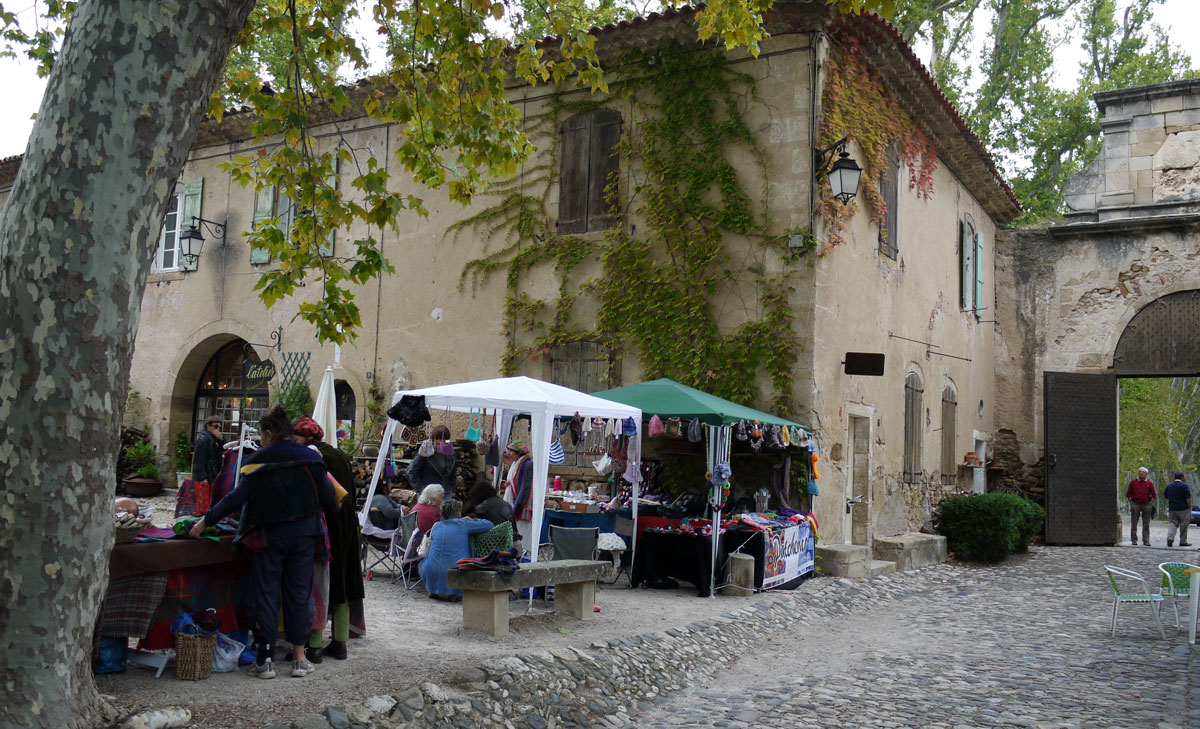
Driving down a local road we saw a sign for a restaurant we had been told about. Turning into the little road the sign pointed to, we came upon the town of Villeneuvette--a walled village from the 15th century or earlier. And in the middle of the town was a wool weavers fair. 

A serious wool weaving fair with weavers dressed in wool clothing that was rural French couture well before the reign of Louis XIV. There was a wool spinning exhibition and people were selling everything from wool toys to wool pillows. And they had a table for a hands-on kids wool class, complete with background music performed by an accordion player. Or maybe the accordion player was with the wine bar? I wasn’t sure but a good, though weird time was being had by all.


The other interesting thing about Villeneuvette is that it is a better example of community redevelopment than anything I’ve seen in the states. No Main Street Projects or Civic improvement group. The town was falling apart for years and the final blow was the loss of their water due to some changes in the water level due to expanded demand from the bigger towns.


So the folks got together and went back to their roots to pull the town together. First they got the water system repaired by pressuring the regional government and then they turned to their past for their future.
Villeneuvette had been a textile town for centuries. It was known for the quality of their products. So the town used its skill in making fabric to become a ‘crafts village.’ The restaurant anchors the town and draws people to it and then there are several small shops selling fabric and other things and there is a crafts gallery.
Okay it’s a gorgeous setting. The town is surrounded by vineyards and it really looks like a village out of the 16th century. Well that doesn’t hurt but it’s the pride of the people that got to me. They call it a renaissance and that’s true.
All in all that was a pretty good discovery to make on a lazy Sunday when we weren’t even looking for anything to do.


Photos and text © 2010 Steve Meltzer